by Nell Fliehmann
Nell Fleihmann from Oakland is 103 years old and is the mother of Jack Fleihmann who lives in Concord. She is among the very few individuals still living who can recount the experience of enduring the German occupation during World War II.
In 1933, Nell resided in Holland. At just 10 years old, she could not have realized that Hitler’s ascent to power in Germany would soon dramatically alter her life. The change was abrupt.
She has documented her experiences living under the German occupation of the Netherlands in a 50-page booklet, which she has kindly shared with the Diablo Gazette. The series starts with February 2026 edition.
Foraging for Food
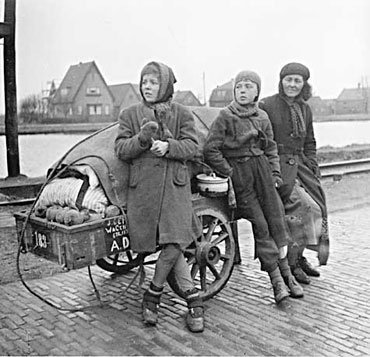
Many people from the cities made trips to the farmers in the Province of Friesland, in northeastern Holland.
My sister and I decided to do the same. By then I was 22 years old and my sister Truus was 24, strong enough to undertake long tiring bicycle trips.
My father bought us four new bicycle tires on the black market. My mother prepared a small bag lunch to take along for the first day. She gathered items to trade with the farmers.
We decided when and where to go in Friesland and packed a change of clothes. Women did not wear pants is those days so we bicycled in skirts. In hindsight, that was probably safer for us.
Early in the morning we left. After hours of bicycling a hundred miles, we arrived at dinnertime in the village of Den Oever. The little town is situated at the beginning of a bridge on a dike, in those years called the Zuiderzee dike.
In this little hamlet we asked around to find a roof over our head for the night and were very lucky to find a room with a wonderful family. The woman was just the most warm-hearted person we could have found. We were invited to sit down for dinner with her family; two little boys, and a husband. Dinner was simple, but good.
Before we went to bed in the tiny bedroom, our hostess gave us some helpful information for our trip across the long bridge the next morning. The woman charged us a small sum for our stay. She really did not make any profit, considering we had dinner and breakfast for two.
On this trip we discovered that people in the country were very sympathetic to the plight of their countrymen around the towns and big cities. Food shortages were not as bad in the country as in the West. Everywhere we went on this trip, people went out of their way to help.
Early the next morning, we bicycled to the guard building at the entrance to the dike. We stopped and went inside a small building to get permission from the two German guards to cross the bridge.
The woman had told us the time when one particular guard would be there. He was known to be more lenient. Trous and I hated to have to be friendly with our enemy. These men were obviously happy with some company from young girls, however brief. We were out of there in no time.
Bicycling on the long bridge, we were not protected from the elements. A strong cold northwesterly wind was gusting into our faces, slowing us down and we really had to step on the pedals.
Years later, on a tour bus with my husband, I went over that same bridge and I realized then how very long and cold that trip must have been.
There was little traffic on the bridge. The bridge separates the sea from the inland waters. It is built on a dike and has traffic lanes in both directions for cars and bicycles.
We had with us some gold jewelry and also, tea; my mother had a great supply of tea when the war started. My father’s knee high fishing boots were in great demand.
We would bicycle up to the front door of prosperous farmhouses. Sometimes we were invited in for lunch. The people were eager to hear from us how things were where we lived. The farmers were more than generous giving us cheese, butter, beans, flour, etc. Butter did not suffer much in our bicycle bags, because it was fairly cold outside.
Accommodations for the Night .
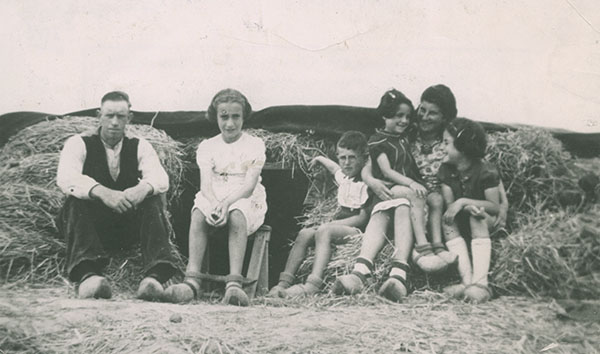
That night we slept on a tall hayloft with many other people from the city. That was the first and only time I ever slept on a haystack. When full, the stack is very high, has an adjustable roof and one has to climb a long ladder to reach the top. These stacks were huge and very wide at the top.
The best way to get hay fever is sleeping with hay right under the nose. But we were tired and slept well, with our money safely tucked in a money belt around our necks.
With effort, and help from others, we pulled our packs of food up the rickety steps and covered these with hay. Because this was the beginning of our trip, we did not have much food at this point.
The next night we could not find any accommodations. So, we went to the police station. They took us in and we slept with dozens of city people on the floor. Having a young body, fortunately, I did not have to get up in the middle of the night.
The floor was pretty hard and my improvised pillow made of a jacket, was not comfortable. Upon our arrival we asked one police man what to do with our packs. He was nice enough to lock these away in a closet.
Two years previous, while on a sailing trip in that area, Truus and I had become acquainted with a young shoemaker. He told us to be sure to stay with him if we ever returned to that area. We looked him up and he was now married. The newly married couple invited us for dinner and we could sleep there, albeit not too comfortably in chairs.
Unfortunately, dinner was too rich for me, and during the night I felt sick, so I wanted to go to the toilet. We slept in the living room and a trip to the facilities went through the kitchen and then out in the open where it was very cold, across the garden to an outhouse. In those years, homes in the country still had outhouses. Without a flashlight this became a true ordeal. It was not entirely dark outside, but the outhouse was pitch black. Not feeling well, walking in the cold night air without a coat, I was miserable.
Our accommodations were not exactly five-star hotels: a haystack, exposed to the cold outside elements, a hard linoleum floor at a police station, two chairs each at the shoemaker.
Most hotels in the country were now closed. Our dinners were often better than at home and in the most unexpected places. I do not recall how many of these long, tiring, but eventful trips we made, back and forth to Friesland. Perhaps four in all.
Large double bags were slung over the rear of our bicycles. Many times on the way home, when I got off the bike, the front would lift up, because all the weight was in the rear.
While we were still in Friesland, on the way back to cross the Zuiderzee bridge, we were stopped by a man wearing an armband stating that he was a food inspector. What we did was not allowed. By now the Germans had forbidden this type of foraging. He looked at our bulging sacks and asked us what we were transporting. My heart skipped a beat. I thought we would have to hand over everything. (We knew he was legitimate) I told him that there was not much in those sacks, nothing important, just some beans that had been given to us.
“OK, on you go then. Have a good day”. We were incredibly relieved; I was ready to hug the man, who knew damn well that we had more than beans with us.
Bicycling back over the bridge, we went straight to the house of the friendly woman. We had pre-booked the night with her for the return trip. She told us that we were always welcome and on our successive trips to Friesland, we would stop there again for an overnight.
I will never forget their kindness towards us. This is so long ago that I have forgotten her name as well as the names of other persons we met on these trips.
The next day we bicycled home and my father was overjoyed with the food we brought home.