by Nell Fleihmann
Nell Fleihmann, Oakland, is 103 years old and is the mother of Jack Fleihmann of Concord. She is one of a very few people still alive to tell the story of living through Germany occupation during World War II.
In 1933, Neil lived in Holland. She was only 10 years old and would have no understanding that Hitler’s rise to power in Germany would relatively soon change her life. It was sudden.
She has written her experience of life under the German occupation of the Netherlands in a 50-page booklet that she has shared with the Diablo Gazette.
This is the fourth installment of her story. You can find the first three installments from previous editions at diablogazette.com beginning with the February 2026 issue.
Some Partying Around the Curfew
A year into the war, we began to have a curfew and we were not allowed out in the streets after eight at night. I was about nineteen years old and from time to time friends and I managed to get together.
One night my boyfriend, Kees, myself, and some others, went to a party. Shortly before eight we left that party in a private home and walked a long distance to another party. By now it was after eight and we were cautious. It was pitch dark outside, streetlamps did not burn, homes were not permitted to show any light, heavy curtains or black shades were tightly closed.
Our second party was in a dress boutique in The Hague. It had a big parquet floor in the center of the store. This became our dance floor for the night. Good dance music on gramophone records had been brought in and legally purchased beer was available and plentiful. There was quite a crowd of young people, friends of friends.
Kees and I both loved to dance, and had been doing this for hours, starting at the first party, when all of a sudden some policemen popped in. Since it was forbidden to gather in groups of this size, the crowd quickly dispersed in all directions, upstairs, downstairs, and through the back door.
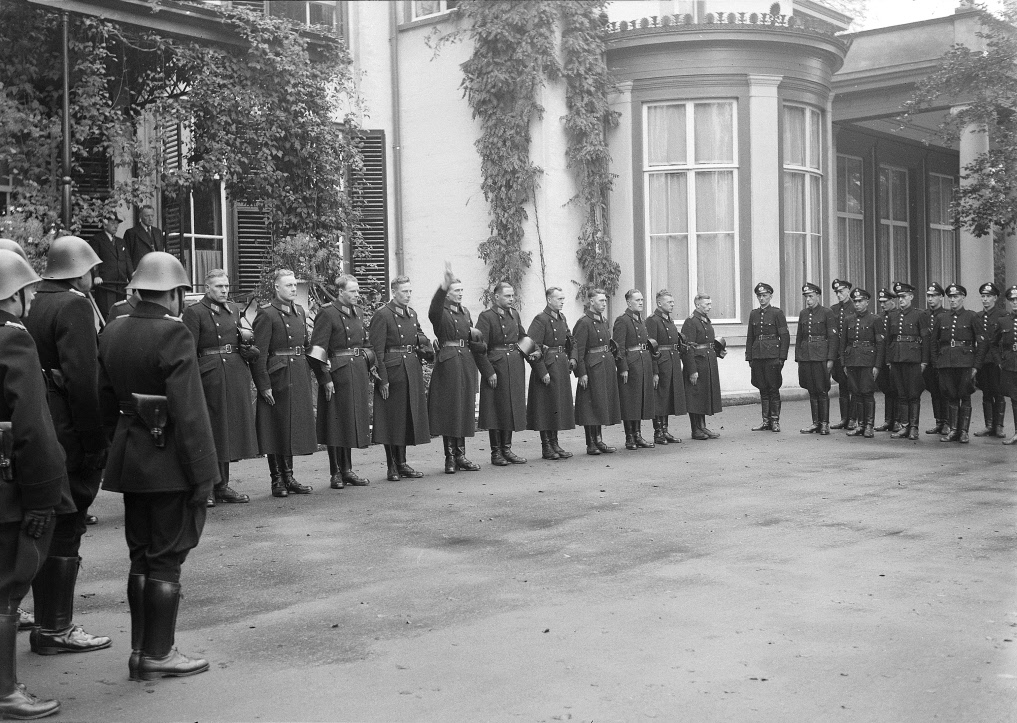
It turned out that these Dutch police men were OK. A dance contest was arranged and the cops were asked to be the jury. Kees and I had been dancing for hours by now. The police voted us the number one couple. We won a bottle of Champaign, which someone had donated.
Dutch police had a very difficult task during the war. They could not afford to lose their jobs, but now received orders from the Germans, while being sympathetic to the plight of Dutch citizens.
For about three years during the occupation, I took the streetcar to The Hague where I worked as secretary. Thereafter, streetcars no longer ran due to a lack of maintenance and spare parts. I had a bicycle but the tires were bad. So, I quit working.
Severe Food Rationing
By 1943 food rations were insufficient. New clothing was no longer to be had. Neither were many other items, such as bicycles, tires, toys, because the Germans looted all factories and warehouses.
Our town, Wassenaar, leased out land, suitable for agriculture, so people could grow vegetables. My father rented a plot and enjoyed growing his own vegetables. He had also located a source of beer, available without coupons. It was nice having a glass of beer with our meals, and it was filling.
From time to time my mother was able to get blood sausage made of pure blood with a thickening agent. This type of sausage had not been sold before. Under normal circumstances I would never have consumed pure blood and would had left that to the Maasai tribesmen in Africa, but I was hungry enough to do this now and grew to like the way my mother fixed it, fried with a thick slice of baked apple on top. After the war ended, and we had sufficient food once again, I wanted no more blood sausage. We tried to eat boiled tulip bulbs but did that only once. Nettles, which grew along the highways, were quite edible, when cooked
One day I bicycled to the office where I should be working. I had not given my notice, nor had I been fired. I had been told that a black-market dealer came by weekly to sell food stamps. We all bought stamps and unbeknownst to the dealer, he dropped quite a few sheets with stamps on the ground. I immediately put my shoe on these. After he left, I shared my bounty with my co-workers. I had absolutely no qualms about this, inasmuch as I had questioned how the man got the food stamps, and I also knew that he made a bundle from these sales.
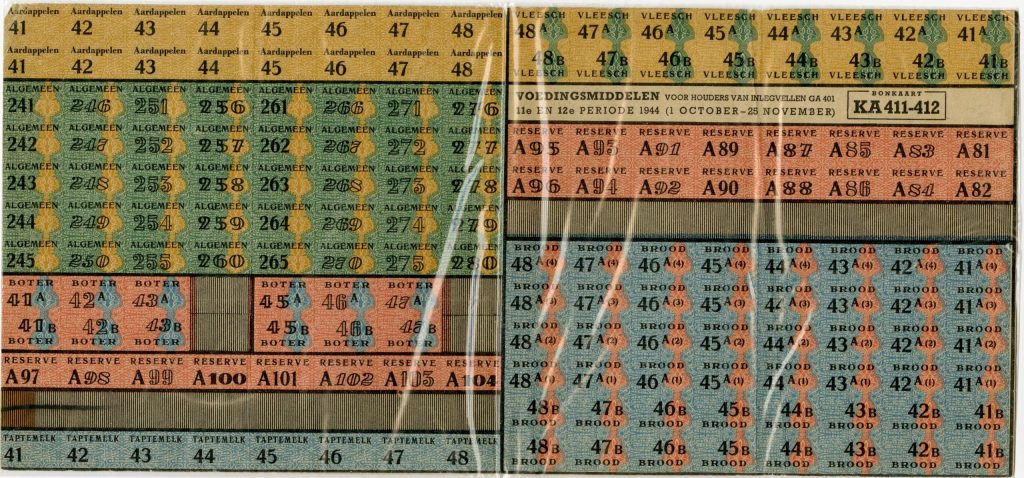
In England these same stamps were printed and given to couriers to take to Holland, where the underground movement used them to get food to Jewish persons in hiding. As a matter of fact, many fake papers and licenses found their way from the presses in England to the underground in Holland.
During the five years of occupation, the food situation gradually became worse. We received less and less food. By the fourth year the situation began to have a great effect on all of us. My father had the hardest time coping.
I recall one time when he was mowing the rear lawn. It was a beautiful sunny day. My sister Truus and I were sit-ting on the patio, leafing through pages of old glossy American magazines to look at photographs of food. This was too much for my father and he became irritated. I asked him “why”? He could not bear to see his daughters go hungry. We assured him, “Dad we are having fun doing this.”
Occasionally on Saturdays, a colleague of mine stopped by. He knew that was the day my mother baked sweet bread from flour we got from items my sister and I had traded. The bread had grated apple and cinnamon in it. My mother would serve this man a thick slice of the bread and we’d have tea together. My father was not happy about these visits, since he was hungry all day long. In many households, relations became strained due to the many difficulties that arose in those times and the stress people lived under. When the war ended there were quite a few divorces.
Next month, “Hunger Winter of 1944-1945”